

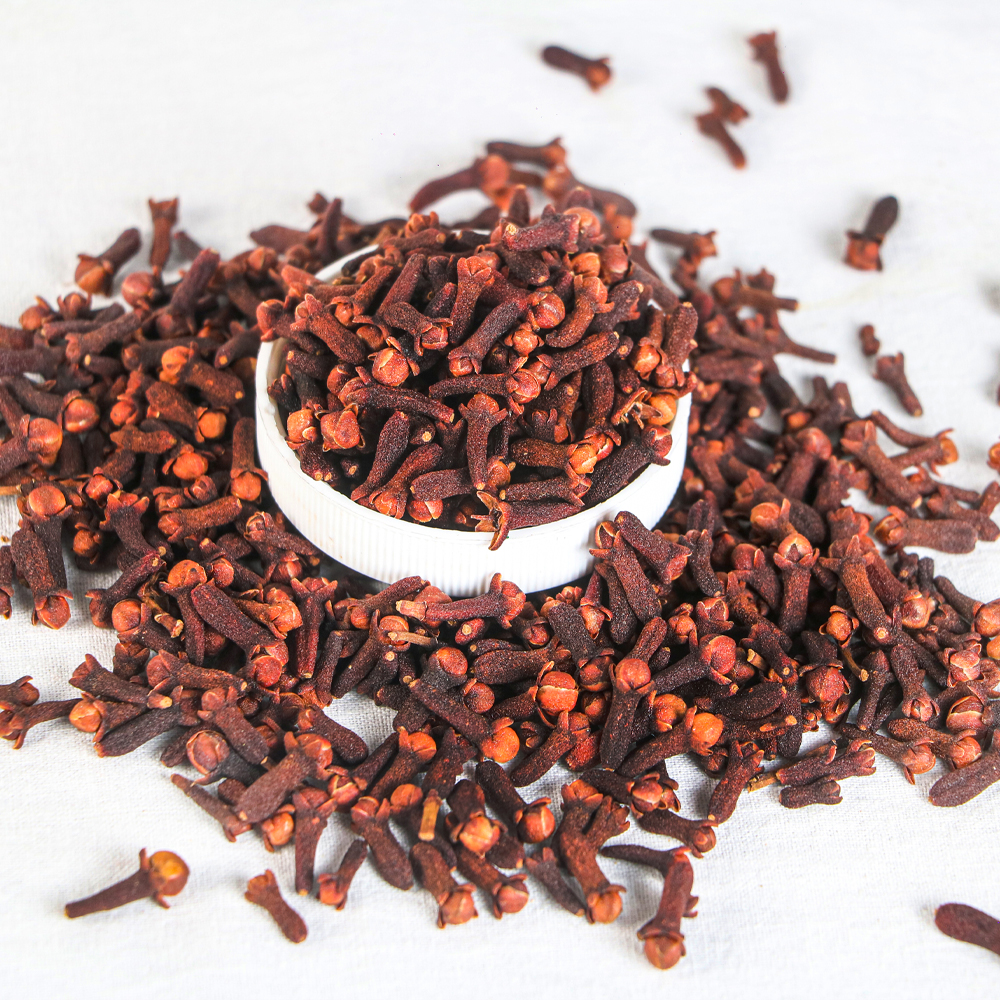
BOTANICAL NAME OF CULINARY SPECIES – Eugenia caryophyllus
PLANT FAMILY – Myrtaceae
COUNTRY/REGION OF BOTANICAL ORIGIN – Molucca Islands
MAJOR COUNTRIES OF CULTIVATION – Madagascar, Zanzibar, India, Sri Lanka
SEASON OF HARVEST – Spring to early summer
PARTS USED – Unopened buds
COLOR – Dark brown, with creamy orange heads
Eugenia caryophyllus is another spice cultivated all around the world. Mostly in Sri Lanka. Just setting foot on the islands gives a visitor a sense of what treasures lie throughout the countryside. The clove tree is an evergreen that grows up to 8–12 metres (26–39 ft) tall, with large leaves and crimson flowers grouped in terminal clusters. On the more pungent end of the taste spectrum, cloves can actually be intense enough to “burn” the palate unless well blended in a dish, and even then, in sparing amounts. The taste is similar to the peppery, sweet heat of allspice but with an even more edgy bite. Cloves are much more powerful than these more-tepid flavour cousins and therefore less is used in a recipe or blend. Some people find the flavour of cloves overwhelming and choose to leave this spice out entirely. Buying whole cloves, you can easily produce ground cloves when needed. This is desirable because ground cloves, like any ground spice, will quickly lose potency and depth of flavour.
The best grade of cloves will have an intact, rounded tip of a lighter orange beige. Avoid samples where this head is as dark as the stem, or with excessive breakage of the rounded portion, which happens as the cloves become more brittle with age. The important flavouring oils rapidly dissipate as well, leaving behind only the strongest bite with none of the corresponding sweetness of a freshly dried batch. Cloves are harvested at 1.5–2 centimetres (0.59–0.79 in) long, and consist of a long calyx that terminates in four spreading sepals, and four unopened petals that form a small central ball. Cloves also feature in any number of desserts, especially ground cloves, and particularly around the holidays. Think eggnog or pumpkin pie spice. Cloves are often paired with cinnamon or nutmeg, but in general, it’s a good idea to use cloves sparingly.
Clove oil, extracted commercially, has numbing intensity. It’s so strong that it’s been used historically as a painkiller. It was this potency that allowed it to become a globally traded commodity during the era before overnight delivery. Even with several years of aging in transit, cloves could continue to impart flavour thousands of miles away from their source. Cloves are often found studding a holiday ham, in Indian biryani dishes, or in pumpkin pie spiced drinks and desserts. cloves have been relegated to sweets in the West but are beginning to re-emerge in savoury dishes. The rest of the world has never forgotten their power in meat rubs, curries, and pickling. Certainly, they can work well in sweet mixes with nutmeg and cinnamon, but matching them with savoury herbs like sage or peppery blends accomplishes the often-elusive balance between sweet and heat. Canadian meat pies, a favourite, call upon cloves as a top note amidst spices that would otherwise be dark and heavy. You can buy “Original Clove” which are harvested in Sri Lanka from Ceylon Spice Corridor.
Reviews
There are no reviews yet.